



Our map will help you find nearby destinations, sites based on your interest, or both! Just choose the types of sites you wish to see and the area you wish to explore. Click on a site to learn more.
Legend
 8th Judicial Circuit
 Courthouse
 Friends of Lincoln
 Good for Kids
 Guided/Self-Guided Tours
 Historic House
 Historic Site
 Lincoln-Douglas Debate
 Museum
 Passport Site
 Recreational
 Route 66
 Top Destination
 Underground Railroad
 Visitor Information
 Wayside Exhibit
Wayside Exhibit Sites

"My Good Friend"
1000 Monroe Dr. Bloomington, Illinois 61701
The beautifully restored, nineteenth-century estate tells the story of Judge David Davis, whose influence on Abraham Lincoln's legal and political career was crucial to President Lincoln's success. Lincoln often visited his friend, fellow lawyer and political advisor here at his home.
Looking for Lincoln wayside exhibits tell the stories of Lincoln’s life and times in Illinois. Each wayside exhibit tells a unique Lincoln story and a local story. Many of the waysides share little known stories about Lincoln and the individuals he interacted with. There are over 260 Looking for Lincoln waysides in the Abraham Lincoln National Heritage Area.
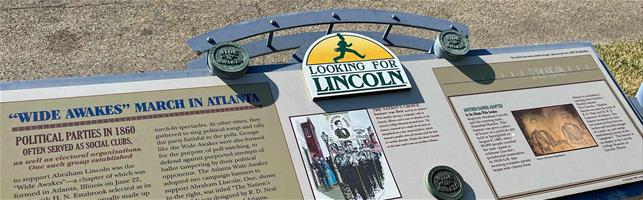
"Wide Awakes" March in Atlanta
112 SW Arch Atlanta, Illinois 61723
Looking for Lincoln wayside exhibits tell the stories of Lincoln’s life and times in Illinois. Each wayside exhibit tells a unique Lincoln story and a local story. Many of the waysides share little known stories about Lincoln and the individuals he interacted with. There are over 260 Looking for Lincoln waysides in the Abraham Lincoln National Heritage Area.
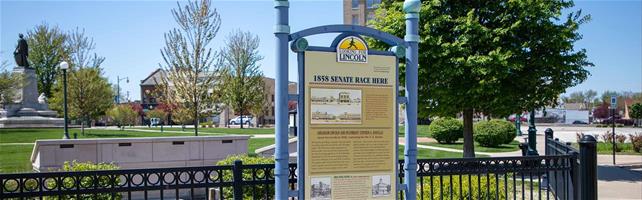
1858 Senate Race Here
NorthEast Corner of Central Park, 155 N Mauvaisterre St, Jacksonville, IL 62650 Jacksonville, Illinois 62650
On Monday September 27th Lincoln arrived in Jacksonville by train from Springfield and was met by large delegations from Morgan, Cass, and Scott Counties. They moved from the depot to the square where Lincoln made one of his sixty-three speeches he had done across the state, contesting for the U.S. Senate. Lincoln was said to have spoken for two and a half hours.
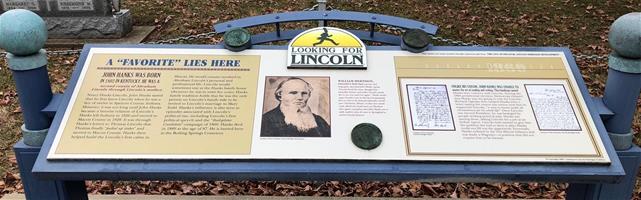
A "Favorite" Lies Here
2418 Boiling Springs Rd. Decatur, Illinois 62526
John Hanks was a favorite relation of Lincoln’s through his mother Nancy Hanks’s family. John moved to Macon County in 1828 and it was his letters to Thomas Lincoln, Abraham’s father, that motivated Thomas to move his family to Illinois in 1830. Abraham remained close to John and was involved in his political rise. John died in 1889 at the age of 87 and is buried at Boiling Springs Cemetery.
Looking for Lincoln wayside exhibits tell the stories of Lincoln’s life and times in Illinois. Each wayside exhibit tells a unique Lincoln story and a local story. Many of the waysides share little known stories about Lincoln and the individuals he interacted with. There are over 260 Looking for Lincoln waysides in the Abraham Lincoln National Heritage Area.
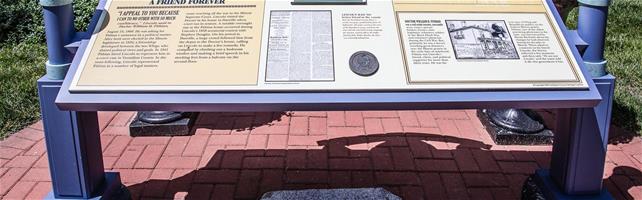
A Friend Forever
Vermilion County Museum 116 N. Gilbert St. Danville, Illinois 61832
This Looking for Lincoln wayside exhibit tells the story fo Lincoln's friendship with Dr. William Fithian, client, friend, and pioneer physician. Located on the grounds of the Vermilion County Museum this exhibit rests below the balcony from which in stocking feet, Lincoln spoke to a waiting crowd.
Looking for Lincoln wayside exhibits tell the stories of Lincoln’s life and times in Illinois. Each wayside exhibit tells a unique Lincoln story and a local story. Many of the waysides share little known stories about Lincoln and the individuals he interacted with. There are over 260 Looking for Lincoln waysides in the Abraham Lincoln National Heritage Area.
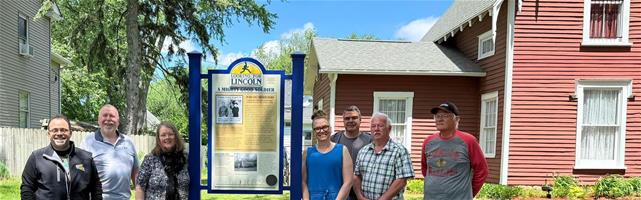
A Mighty Good Soldier
401 W. Livingston St. Pontiac, Illinois 61764
Learn about Civil War veteran, Albert Cashier, and his lifelong secret.
Looking for Lincoln wayside exhibits tell the stories of Lincoln’s life and times in Illinois. Each wayside exhibit tells a unique Lincoln story and a local story. Many of the waysides share little known stories about Lincoln and the individuals he interacted with. There are over 250 Looking for Lincoln waysides across the Abraham Lincoln National Heritage Area.
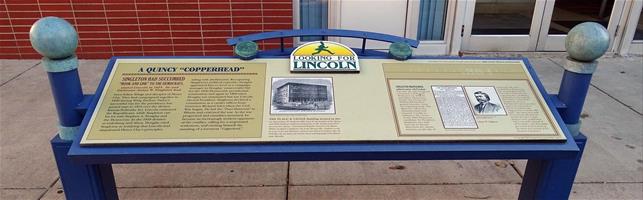
A Quincy "Copperhead"
Southwest Corner of 5th & Maine St. Quincy, Illinois 62301
James W. Singleton was both Lincoln’s friend and a political opponent. Learn why the two former Whigs went different directions and about Singleton’s “Copperhead” opposition to the Civil War. Also find out how Singleton helped reelect Lincoln as President.
Looking for Exhibits Wayside Exhibits related to Quincy in the Lincoln Era are located at 18 sites. The exhibits provide details about Lincoln, events, local people, and environment that contributed to Lincoln's Quincy story.
Guide to Lincoln's Quincy: https://seequincy.com/wp-content/uploads/2014/05/lincoln-in-quincy_web_2016.pdf
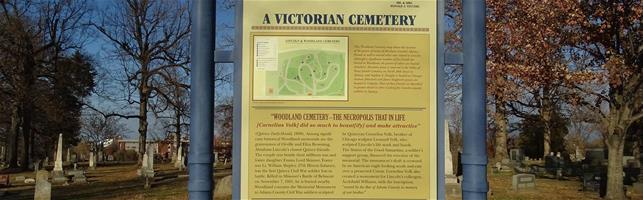
A Victorian Cemetery
1020 S 5th St. (Triangle Inside Cemetery Entrance) Quincy, Illinois 62301
One of the most significant Victorian cemeteries in the Midwest and listed on the National Register, Woodland Cemetery is an example of the rural cemetery movement of the 1800s. Learn how it records community history and has a “garden cemetery” setting. Find out more about Lincoln’s friends buried there, and discover Cornelius Volk’s memorial monument to Civil War soldiers.
Looking for Exhibits Wayside Exhibits related to Quincy in the Lincoln Era are located at 18 sites. The exhibits provide details about Lincoln, events, local people, and environment that contributed to Lincoln's Quincy story.
Guide to Lincoln's Quincy: https://seequincy.com/wp-content/uploads/2014/05/lincoln-in-quincy_web_2016.pdf
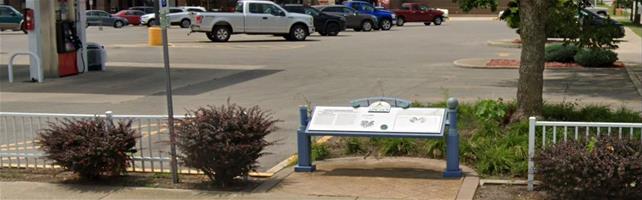
Abe Lincoln Stranded Here
299 N Oak Street Pontiac, Illinois 61764
200 Block of North Oak Street - by County Market Grocery
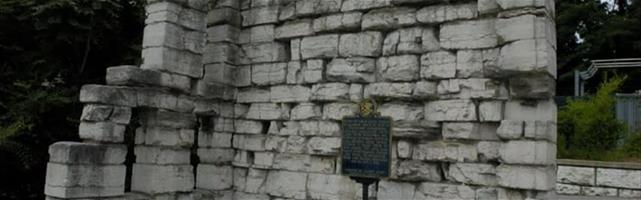
Alton Prison
William Street & Broadway Street Alton, IL 62002
In just three years, more than 11,700 Confederate prisoners passed through the gates of the Alton Prison and were held captive with its walls. The Alton Prison, opened in 1833 and closed in 1860, was the first Illinois State Penitentiary. In December of 1861, after inspecting the facilities, Major General Henry Halleck, Commander of the Department of the Missouri, prepared to have the prison re-opened as a the Alton Federal Military Prison.
On Feb. 9, 1862, the first prisoners arrived at the prison. Inmates of the prison included Confederate soldiers, citizens imprisoned for treason acts, and bushwackers or guerillas imprisoned for acts against the government. Much of the time, the prison was overcrowded, prisoners were malnourished and had inadequate clothing.
Under these dilapidated conditions, prisoners were exposed to influenza, dysentery and small pox. The small pox epidemic grew in numbers, and the official military death toll listed 1,354 deceased. A monument dedicated to those who perished can be found at their burial site in the Confederate Cemetery.
After the war, the prison was privately purchased and building blocks were removed. The remaining small portion of the wall was restored in 1973 and may be visited today.
Pages: [ 1 2 3 4 5 6 7 8 9 10 11 12 13 14 15 16 17 18 19 20 21 22 23 24 25 26 > >> ]